
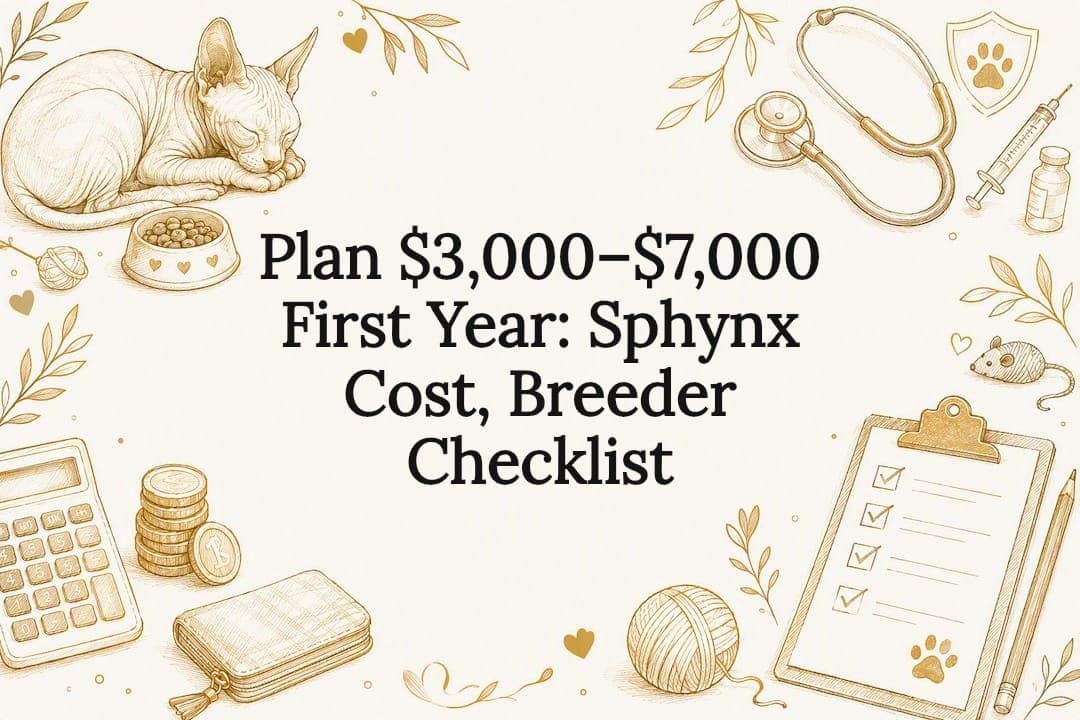
A pet-quality Sphynx kitten from a reputable breeder typically runs $1,500 to $6,000, with most families landing between $2,000 and $5,000. Rescue adoption fees sit far lower, usually $75 to $600. Once you add setup gear and first vet visits, budget roughly $3,000 to $7,000 for year one, then $1,500 to $3,000 a year after that.
TL;DR:
- Rescue adoption offers significantly lower costs but comes with longer waits and mostly adult cats, while breeder kittens cost between $2,000 and $5,000 with health testing.
- First-year expenses including setup, veterinary care, and initial screenings can total $3,000 to $7,000, with ongoing annual costs ranging from $1,500 to $3,920.
- Sphynx ownership costs are higher than most breeds due to regular skin baths, cardiac screenings, higher food needs, and potential emergency veterinary bills.
- Verifying health documentation, especially for hypertrophic cardiomyopathy, and visiting the breeder are key steps to avoid health risks and scams.
- Responsible breeders provide transparent health records, raised kittens, and thorough care guidance, making verification more valuable than price alone.
Table of Contents
- Sphynx Cat Cost by Purchase Path: Adoption, Pet-Quality, and Show-Quality
- Adopting vs. Buying From a Breeder: Which Route Actually Fits You
- Building Your First-Year Sphynx Budget: Setup Costs, Vet Bills, and Monthly Expenses
- Why Sphynx Cats Cost More to Own Than Most Breeds
- Evaluating a Breeder: What to Ask Before You Pay a Deposit
- Where Charming Sphynx Fits Into a Responsible Purchase Decision
- Why Buyers Keep Underbudgeting This Breed
- Ready to Bring Home a Health-Checked Sphynx?
- Sources
Sphynx Cat Cost by Purchase Path: Adoption, Pet-Quality, and Show-Quality
The price you pay depends almost entirely on where your kitten comes from and what work has already gone into it. Three lanes cover nearly every buyer: rescue, pet-quality breeder, and show-quality or breeding-rights.
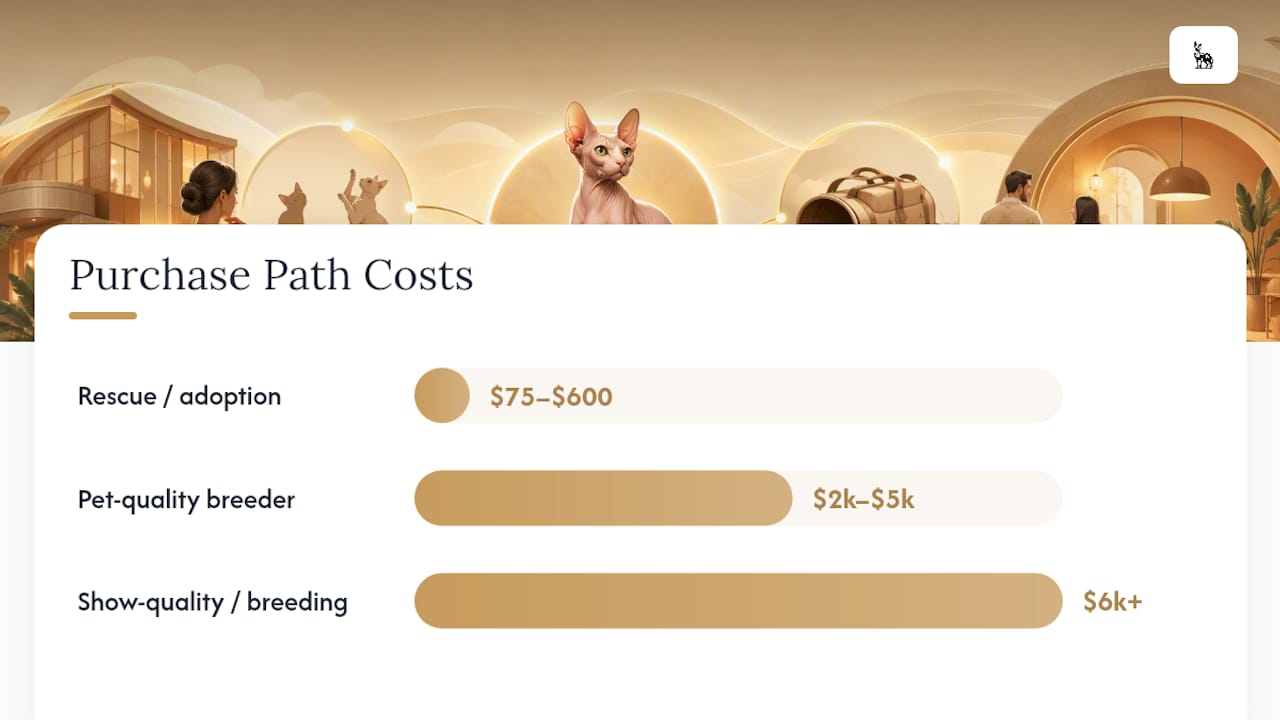
Rescue and breed-specific adoption groups charge $75 to $600, and that fee usually already covers spay or neuter, vaccines, and a microchip. It's the fastest way into Sphynx ownership on a tight budget. Though availability is inconsistent since hairless cats rarely land in shelters.
Pet-quality kittens from a screened breeder usually cost several thousand dollars, with variations depending on lineage and coat pattern. You're paying for a kitten that's been health-tested, vaccinated, and sold under a written limited contract that typically restricts breeding rights.
Show-quality kittens or breeding pairs typically cost more due to rarer bloodlines, championship potential, and full breeding rights. Most families never need this tier. Regional variance matters too. Coastal metro breeders often price higher than rural catteries, and buying out of state may add several hundred dollars for climate-controlled transport.
| Purchase Path | Typical Price | What's Usually Included |
|---|---|---|
| Rescue/adoption | $75 to $600 | Spay/neuter, vaccines, microchip |
| Pet-quality breeder | $2,000 to $5,000 | Health checks, vaccines, limited contract |
| Show-quality/breeding rights | $6,000+ | Full pedigree, breeding rights, top bloodlines |
Adopting vs. Buying From a Breeder: Which Route Actually Fits You
Money isn't the only variable here, and treating it as the only one leads to regret either way. Adoption saves cash up front, but a breeder purchase buys you certainty about health and temperament that a rescue simply can't promise.
- Adoption fees are lower and often bundle spay/neuter, vaccines, and a microchip into one price.
- Rescue Sphynx cats are rare, so you may wait months for one to appear, and most available cats are adults, not kittens.
- Breeder prices run higher partly because responsible breeders spend several hundred dollars per breeding cat annually on HCM scans and genetic testing, then pass a slice of that cost forward.
- A breeder contract typically guarantees health for a defined period and gives you documented lineage, something no shelter intake paperwork can replicate.
- Short-term savings from a cheap adoption can evaporate fast if an undiagnosed heart condition surfaces at eighteen months old.
If you want a kitten with known parentage and cardiac screening on record, a breeder is worth the premium. If you're open to an adult cat and want to save money now, rescue is the better math.
Building Your First-Year Sphynx Budget: Setup Costs, Vet Bills, and Monthly Expenses
Your kitten's price tag is just the entry fee. The real budgeting work happens in the weeks and months after you bring one home.
One-time setup costs:
- Carrier and travel gear: $30 to $80
- Heated cat bed (nearly mandatory for a hairless breed): $25 to $70
- Grooming kit with hypoallergenic shampoo: $20 to $50
- Litter box, scratching post, and toys: $50 to $120
Initial veterinary costs typically include core vaccines, a wellness exam, microchipping, and spay/neuter if not already done, usually $150 to $400 combined. Many vets also recommend a baseline echocardiogram to screen for hypertrophic cardiomyopathy (HCM) early, and that scan alone runs $300 to $600 in most U.S. metro areas.
Pro Tip: Ask your breeder whether the parents have documented HCM clearance. If they do, your kitten's baseline echocardiogram becomes a smart precaution rather than an urgent diagnostic, and you can often schedule it later in the first year instead of week one.
Recurring monthly costs include premium food, litter, skin-care supplies, and heating adjustments, plus pet insurance if you choose it. Owners typically spend $130 to $330 a month, which works out to roughly $1,540 to $3,920 a year in ongoing care.
| Budget Tier | Year-One Total | Ongoing Annual |
|---|---|---|
| Low (adopted, minimal extras) | $1,500 to $6,000 | $2,000 to $5,000 |
| Typical (breeder kitten, standard care) | $3,000 to $7,000 | $1,500 to $3,000 |
| High (breeder kitten, insurance, full screening) | $3,000 to $7,000 | $1,540 to $3,920 |
The gap between the low and high scenarios comes down almost entirely to insurance, elective HCM screening, and whether you buy from a breeder or adopt.
Why Sphynx Cats Cost More to Own Than Most Breeds
Hairless skin isn't just a look. It's a maintenance obligation that touches nearly every line item in your budget, and it's the reason Sphynx ownership costs more than owning a short-haired domestic cat with similar demeanor.
- Weekly or biweekly baths are mandatory since Sphynx skin produces oils that a fur coat normally absorbs; do-it-yourself supplies cost a modest monthly amount, while professional grooming sessions are more expensive per session.
- HCM is disproportionately common in the breed, and cardiologists recommend periodic echocardiogram monitoring at $300 to $600 per scan, not a one-time test.
- Dental disease shows up often enough that professional cleaning under anesthesia, including pre-op bloodwork, can run several hundred dollars to over $1,000 if extractions are needed.
- Higher metabolism from lacking fur insulation means Sphynx eat more relative to body size, and heated beds or warmer home temperatures add to utility bills.
- Emergency vet visits for skin infections, respiratory sensitivity, or cardiac events can run into the thousands, which is exactly why insurance carries real weight for this breed.
Because Sphynx are predisposed to HCM and other breed-linked conditions, insurance is worth serious consideration, and premiums typically run $25 to $90 a month depending on coverage depth. That range sounds wide because emergency vet care for a hairless breed rarely comes cheap. Setting aside $3,000 to $5,000 as an emergency cushion, or securing a policy with a high emergency cap, gives you real protection against surrendering a cat you can no longer afford to treat.
Evaluating a Breeder: What to Ask Before You Pay a Deposit
A good checklist protects both your wallet and your kitten's health, and it takes about fifteen minutes to run through before you commit any money.
- Request documented HCM clearance for both parents, not just verbal assurance.
- Ask for complete vaccination and deworming records tied to your specific kitten.
- Get a written health contract that spells out what happens if a genetic condition surfaces.
- Request a video call or in-person visit to see the cattery's living conditions and how kittens interact with people.
- Confirm the deposit amount, balance due date, and what triggers a refund if health testing fails before pickup.
Watch for sellers who resist showing parental HCM paperwork, refuse any visit, or push you toward wiring money to a personal account instead of a business one. Kittens priced dramatically below $1,500 often signal skipped health testing rather than a genuine bargain.
| Ask For | Why It Matters |
|---|---|
| Parent HCM documentation | Confirms cardiac screening, not just claims |
| Written health contract | Defines your protection if issues arise |
| Cattery visit (virtual or in-person) | Reveals real living and socialization conditions |
| Standard payment method | Wire requests to personal accounts are a scam signal |
Where Charming Sphynx Fits Into a Responsible Purchase Decision
Charming Sphynx breeds with the same documentation standards this checklist demands. Every kitten is health-checked and vaccinated before it leaves the cattery, and kittens are raised with individual attention so social development happens the way it should, not rushed.
New owners get detailed care guidance built specifically for the transition into a hairless cat's routine, from bathing schedules to heating needs. Buyer feedback in customer testimonials consistently points to playful, well-adjusted kittens and a shipping process that goes smoothly. Some breeders connect families across multiple states, so the checklist above (health documentation, contract terms, visit access) can be verified directly rather than taken on faith.
Why Buyers Keep Underbudgeting This Breed
The biggest mistake I see in how people approach Sphynx costs isn't the sticker price. It's treating that price as the finish line instead of the entry point. A $3,000 kitten with no insurance and no emergency fund is a far riskier purchase than a $5,000 kitten backed by documented HCM clearance and a policy with a real emergency cap.
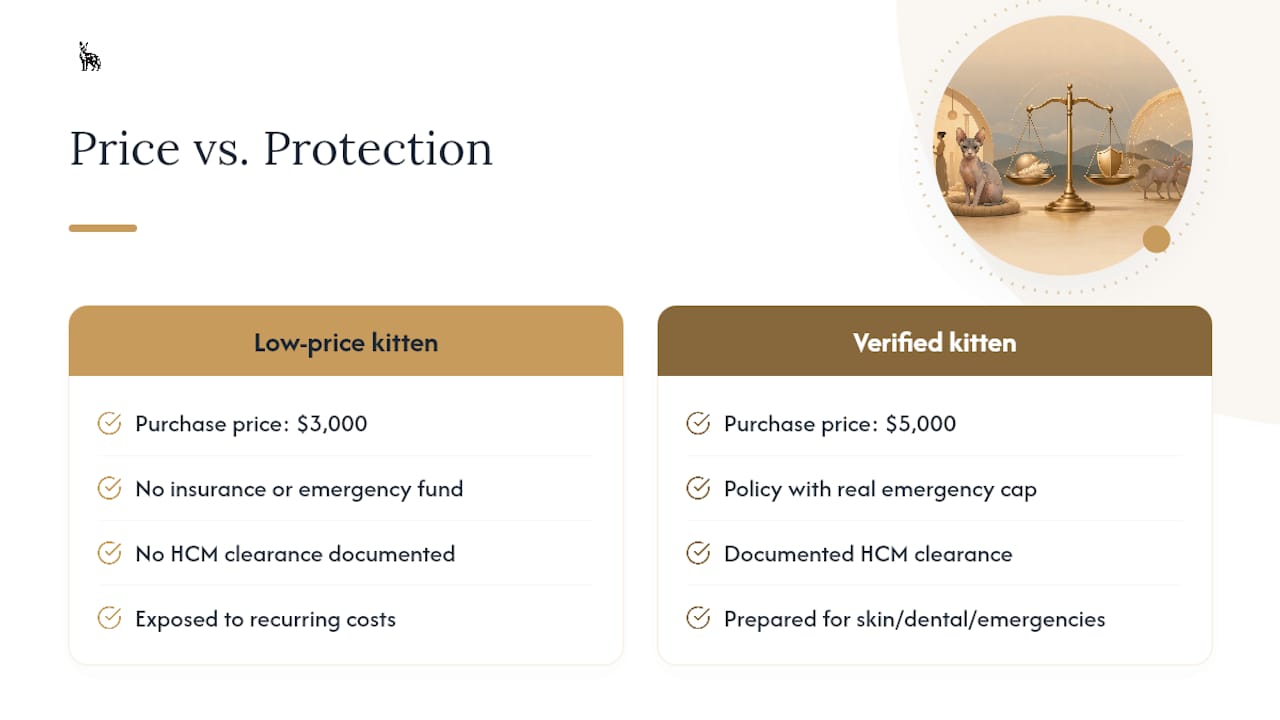
Conventional advice tends to fixate on finding the "fair price" for a kitten, as if getting that number right solves the budgeting problem. It doesn't. The real financial exposure in Sphynx ownership lives in the recurring and unpredictable costs: skin care, dental work, cardiac screening, emergency visits. Treat the purchase price as a down payment on years of breed-specific care, not the main event.
If you take one thing from this guide, prioritize verification over price-hunting. A breeder who freely shares HCM documentation and a written contract is worth more than a few hundred dollars saved from a seller who won't.
— Amanou
Ready to Bring Home a Health-Checked Sphynx?
Some breeders provide kittens health-checked and vaccinated, raised with individual attention rather than mass-produced litters, and backed by care guidance built specifically for hairless cat ownership.
Compare that to piecing together a purchase from an unverified private seller, where you're left independently confirming HCM records, contract terms, and vaccination history with no guarantee any of it holds up. Charming Sphynx keeps that documentation front and center from the start, and kittens are currently available across multiple states nationwide, with regional listings like available kittens in Georgia and new litters in California updated as litters come available.
If the budget ranges above fit your plans, contact the team to ask about current availability and reserve a kitten before the next litter fills up.
Sources
The price bands and health guidance in this article draw from a handful of specialized sources rather than general pet-cost estimators, since Sphynx-specific expenses (HCM screening, skin care, heating) don't show up in typical breed calculators.
Petful's Sphynx cost breakdown supplied the core purchase price bands, adoption fee range, and red-flag pricing threshold. FelineNest's Sphynx price guide provided the monthly ongoing cost breakdown and echocardiogram pricing. EveryPaw's Sphynx insurance and care guide informed the insurance recommendation and premium range. Dental cost estimates came from Hepper's Sphynx cost guide.